Learning materials
Multidimensional Array
On this page
General Multidimensional Array
-
Multidimensional arrays - arrays of arrays
int a[10];  // 1d local array
int a1[2][3];  // 2d local array
int a2[2][3][4];  // 3d local array
int **a3;  // pointer of pointer to int, used for 2D dynamic array
int ***a4;  // pointer of pointer of pointer to int, used for 3D dynamic array
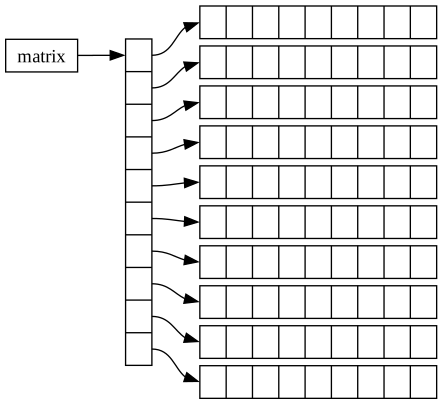
int matrix[10][10]; // a local 10 x 10 2D array
Two dimensional array
-
2d local array
Example: a local array a1 with 2 rows, 3 columns
-
int a1[2][3]; -
a1 has the pointer part of the array with the
int **type -
a1 is an array of 2 element, and each element is an array of 3 int
-
memory allocated on stack memory region
-
initialization syntax
// initialization of 2d array
// a1[0] is {1, 2, 3}, a1[1] is {4, 5, 6}
int a1[2][3] = {{1, 2, 3}, {4, 5, 6}};
int a2[2][3] = {1, 2, 3, 4, 5, 6};
int a3[][3] = {1, 2, 3, 4, 5, 6};  // first dimension can be inferred
-
-
2d dynamic array
Example: a dynamic array dynArr1 with 2 rows, 3 columns
// declaration
int **dynArr1;

// allocate memory (on Heap)
dynArr1 = new int *[2];
for (int i = 0; i < 2 ; ++i)
  dynArr1[i] = new int[3];
//now you can access element using array syntax like dynArr1[0][0]

// put values into the array
for (int i = 0; i < 2 ; ++i)
  for (int j = 0; j < 3; ++j)
    dynArr1[i][j] = i * 3 + j + 1;
// now dynArr1 is {{1, 2, 3}, {4, 5, 6}}

// release memory
for (int i = 0; i < 2 ; ++i)
  delete [] dynArr1[i];
delete [] dynArr1;
- 2d array as a function parameter
-
pass a 2 x 3 local array
- Declared like
int a1[2][3]; - Not useful in real projects because of the limitation on dimension
// ---- wrong ---- void matrixOp(int matrix[rows][cols], int rows, int cols); void matrixOp(int matrix[][], int rows, int cols); void matrixOp(int matrix[2][], int rows, int cols); // ---- correct ---- // only the first dimension can be empty, use int literals // or const variables for other dimensions void matrixOp(int matrix[2][3], int rows, int cols); void matrixOp(int matrix[][3], int rows, int cols); // using const variables const int ROWS = 2; const int COLS = 3; void matrixOp(int matrix[ROWS][COLS], int rows, int cols); void matrixOp(int matrix[][COLS], int rows, int cols); // to call int a1[2][3] = {{1, 2, 3}, {4, 5, 6}}; matrixOp(a1, 2, 3) - Declared like
-
passing a dynamic array, a much nicer solution + declared like
int **dyArr1// correct version 1 void matrixOp(int ** matrix, int rows, int cols) { for (int i = 0; i < rows ; ++i) for (int j = 0; j < cols; ++j) cout << matrix[i][j] << " "; // same syntax as local array } // correct version 2 void matrixOp(int *matrix[], int rows, int cols); // to call the function int **dyArr1; dyArr1 = new int *[2]; for (int i = 0; i < 2; ++i) { dyArr1[i] = new int[3]; // initialize values } matrixOp(dynArr1, 2, 3); // for loop delete [] for (int i = 0; i < 2; ++i) delete [] dyArr1[i]; delete [] dyArr1;
-
-
Returning a Multidimensional array from a function
Just make a dynamic array and return the pointer:
int **createMatrix(int rows, int cols, int value);

int **createMatrix(int rows, int cols, int value) {
  int **result;
  result = new int *[rows];
  for (int i = 0; i < rows; ++i) {
    result[i] = new int[cols];
    for (int j = 0; j < cols; ++j)
      result[i][j] = value;
  }
  return result;
}

int main() {
  int **matrix = createMatrix(3, 5, 1);

  // work on the matrix

  // release memory
  for (int i = 0; i < rows; ++i)
    delete [] matrix[i];
  delete [] matrix;
}
Pitfalls
// bad local array declaration
int arr[rows][cols];  // rows and cols are not compilation-time constants
int arr[][];
int arr[2][];
int arr[][3];

// bad dynamic array related
int **arr = new int[2][3];  // cannot use more than one pair of [] with new
delete arr;  // missing []
delete [2][3] arr;
delete [][] arr;
delete arr[2][3];

// bad function declarations that take local array parameters
void func1(int arr[][], int rows, int cols);
void func1(int arr[2][], int rows, int cols);
void func1(int arr[rows][cols], int rows, int cols);


// bad function declarations that take dynamic array parameters
void func1(int *arr[], int rows, int cols);