Data Structure and Algorithm Design II
Chapter 12
Xingang (Ian) Fang
Sections
Probability in Computing
Randomized Algorithms
Probability in Computer Science
Xingang (Ian) Fang
Overview
Definition: Probability quantifies the likelihood of an event or outcome occurring. It’s a measure of uncertainty of the occurrence of an event.
Applications:
Algorithm Efficiency
Data Analysis and Predictive Modeling
System Reliability
Types of Probability
Classical Probability
Defined for situations where outcomes are equally likely. This method is deterministic in nature. This method is related to combinatorics.
Empirical (or Experimental) Probability (FYI)
Based on observations, experiments, or historical data rather than theoretical calculation.
Subjective Probability (FYI)
Derived from personal judgment, intuition, or belief, rather than any objective or empirical evidence. It’s less formal and more based on individual perspectives.
Basic Rules and Principles of Probability
Probability of an Event
\(0 \leq P(A) \leq 1\) for any event \(A\).
Sample Space and Events
Tossing a coin: Sample space = {Heads, Tails}.
The Additive Rule (mutually exclusive events)
\(P(A \cup B) = P(A) + P(B)\) for mutually exclusive events \(A\) and \(B\).
Complementary Events
\(P(A') = 1 - P(A)\), where \(A'\) is the complement of \(A\).
Multiplicative Rule (independent events)
\(P(A \cap B) = P(A) \times P(B)\) for independent events \(A\) and \(B\).
Conditional Probability (FYI)
\(P(A|B) = \frac{P(A \cap B)}{P(B)}\), provided \(P(B) \neq 0\).
Bayes’ Theorem (FYI)
Based on your initial belief about the probability of an event, Bayes’ theorem allows you to update that belief based on new evidence.
Where:
\(P(A|B)\) is the posterior probability: the probability of hypothesis \(A\) given data \(B\).
\(P(B|A)\) is the likelihood: the probability of data \(B\) given hypothesis \(A\).
\(P(A)\) is the prior probability: the probability of hypothesis \(A\) before seeing the data.
\(P(B)\) is the marginal likelihood: the total probability of observing data \(B\).
Combinatorics in Classic Probability
Card games
Dice games
Lottery drawings
Arranging books on a shelf
Drawing colored balls from a bag
…
Card Games (Poker Hands)
Question: What is the probability of getting a royal flush in poker when dealt 5 cards from a standard 52-card deck?
Solution:
Combinatorial Approach: There are \(C^{52}_{5}\) ways to choose 5 cards from 52, and only 4 ways to get a royal flush (one for each suit).
Probability: \(P(\text{Royal Flush}) = \frac{4}{C^{52}_{5}}\)
Dice Games (Yahtzee)
Question: What is the probability of rolling a Yahtzee (five dice showing the same number) in one roll?
Solution:
Combinatorial Approach: There are \(6^5\) possible outcomes when rolling 5 dice, and 6 possible Yahtzees (one for each number 1-6).
Probability: \(P(\text{Yahtzee}) = \frac{6}{6^5}\)
Lottery Drawings
Question: What is the probability of winning a lottery where you must correctly pick 6 numbers out of 49?
Solution:
Combinatorial Approach: There are \(C^{49}_{6}\) ways to choose 6 numbers from 49.
Probability: \(P(\text{Winning}) = \frac{1}{C^{49}_{6}}\)
Arranging Books on a Shelf
Question: If you have 10 different books and want to place 2 specific books next to each other, what’s the probability this happens at random?
Solution:
Combinatorial Approach: Consider the 2 specific books as one item. There are 9! ways to arrange these 9 items, and 2! ways to arrange the 2 books among themselves. There are 10! ways to arrange all books without any restrictions.
Probability: \(P(\text{2 Books Together}) = \frac{9! \times 2!}{10!}\)
Drawing Colored Balls from a Bag
Question: In a bag with 5 red, 4 blue, and 6 green balls, what’s the probability of drawing 2 red balls consecutively without replacement?
Solution:
Combinatorial Approach: There are \(C^{5}_{2}\) ways to choose 2 red balls and \(C^{15}_{2}\) ways to choose any 2 balls from 15.
Probability: \(P(\text{2 Red Balls}) = \frac{C^{5}_{2}}{C^{15}_{2}}\)
Randomized Algorithms
Xingang (Ian) Fang
Overview
A randomized algorithm is an algorithm that employs a degree of randomness as part of its logic.
A special paradigm that focus on techniques used in the design of algorithms
Combined with other paradigms to produce efficient algorithms
Not the leading paradigm in algorithm design
Characteristics
nondeterministic
probabilistic
Core Concepts
Pseudo-random number generator (PRNG)
A deterministic algorithm that simulates randomness
Use a random seed to generate a sequence of real random numbers
Designed to simulate various distributions, e.g. uniform, normal, etc.
We mostly use uniform distribution in this course
Uniform distribution: equal probability of all outcomes
Random sampling
Select a random sample from a set of items
With or without replacement (allow or not allow repetition of items)
Randomized Algorithms
Genetic algorithms
Random initial population
Tournament selection/roulette wheel selection
Random mutation
Random crossover
Random replacement
Monte Carlo algorithms
Approximate solutions to hard problems
Employs statistics of random samples to estimate metrics of interest like probability, mean, variance, integral, etc.
Examples
Approximate the value of pi
Approximate the value of an integral
Las Vegas algorithms
Always produce correct results
Randomness is used to improve efficiency
Examples
Quicksort with random pivot selection
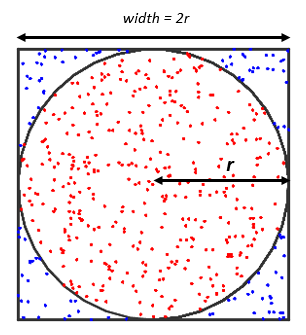
Monte Carlo: Estimation of Pi
Problem: Estimate the value of pi
Solution: Randomly sample points in a square and count the number of points that fall in a circle
The ratio of the number of points in the circle to the total number of points is the ration of the area of the circle to the area of the square
Thus, \(\pi = 4 \times ratio\)