Data Structure and Algorithm Design
Chapter 12
Xingang (Ian) Fang
Sections
Heap
Priority Queue
Heap Data Structure
Xingang (Ian) Fang
Outline
Definitions
Structures
Behaviors
Visualization
Time Complexity
Overview
Definition: A complete binary tree in which parent node is always less/greater (min/max heap) or equal (if allow overlapped values) than all elements in its subtrees.
Two type: min and max heap
Applications
Heap sort
Priority queue
Structures
Logically a complete binary tree
Physically a partially filled array
find parent/children by arithmetic calculation of indices
given the node \(i\)
the index of the parent node is \((i-1)/2\)
the indices of the children nodes are left: \(i*2+1\) and right: \(i*2+2\)
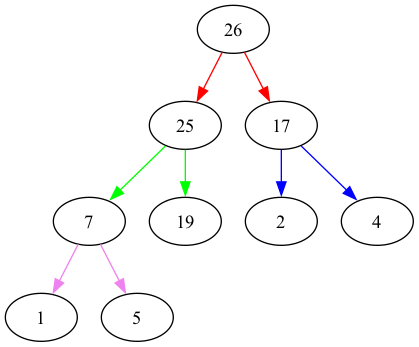
A max heap (tree form)
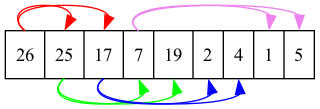
A max heap (array form)
Behaviors
Heapify: make an array of random numbers into a heap
Insert: insert a new element into a heap
insert at the end of the array
percolate up
Delete: delete an element from a heap
use the last element to replace the root
percolate down
Percolate up: move an element up to its proper position
Percolate down: move an element down to its proper position
Visualization
Our Binary Heap Visualizer shows the tree and array views while stepping through heap operations.
Time Complexity
Create a heap
From an array (heapify) \(\Theta(n)\)
Insert one by one \(\Theta(n\log n)\)
Insert \(\Theta(\log n)\)
Delete \(\Theta(\log n)\)
Percolate up \(\Theta(\log n)\)
Percolate down \(\Theta(\log n)\)
Heap Sort
Heap sort is a comparison based sorting technique based on Binary Heap data structure. It is similar to selection sort where we first find the maximum element and place the maximum element at the end. We repeat the same process for remaining element.
Characteristics
Comparison based (general purpose)
Iterative
In-place
Efficient
Unstable - relative order of equal elements is not preserved
Algorithm Details
Heapify the array to build a heap
Removing the root node repeatedly from a heap
move root to the sorted region by swapping it with the last leaf
percolate the root down
Related data-structure demo: our Binary Heap Visualizer steps through heap operations and shows the array/tree representation.
Heapsort visualization: https://www.cs.usfca.edu/~galles/visualization/HeapSort.html
Pseudo Code
function heapSort(arr):
  n = length(arr)

  # Heapify the array
  for i from n/2-1 down to 0:
    percolateDown(arr, n, i)

  # Extract elements from the heap one by one
  for i from n - 1 down to 1:
    # Swap the root (maximum element) with the last element
    swap(arr[0], arr[i])
    percolateDown(arr, i, 0)
function percolateDown(arr, n, i):
largest := i
left := 2 * i + 1
right := 2 * i + 2
# Compare with left child
if left <= n and arr[left] > arr[largest]:
largest := left
# Compare with right child
if right <= n and arr[right] > arr[largest]:
largest := right
# If the largest element is not the root, swap them
if largest != i:
swap(arr[i], arr[largest])
# Recursively percolate down the affected sub-tree
percolateDown(arr, n, largest)Complexity
Time \(\Theta(n \log n)\)
Space \(\Theta(1)\) as an in-place algorithm
Priority Queue Abstract Data Type
Compare priority-queue operations in our ADT Explorer and inspect the underlying heap in our Binary Heap Visualizer.
Overview
Behaviors
Overview
A priority queue ADT is a container of elements that guarantees that the element with the highest priority is the first element to be obtained and removed from the container.
It is not really a queue because it is not FIFO!
Characteristics
Homogeneous
Access order is highest/lowest rank first
Finite
Dynamic size
Applications
Many greedy algorithms
Event-driven simulation
Dijstra’s shortest path algorithm
Behaviors
enqueue: Add an element to the priority queue.
dequeue: Remove and return the value of the element with the highest/lowest rank from the priority queue.
peek: Return the element to be removed from the queue.
isEmpty: Return true if the stack is empty, false otherwise.
size (optional): Return the number of elements in the container.
C++ Implementation of Priority Queue ADT
See our Binary Heap Visualizer for the tree and array representation used by one common implementation.
Use C++ STL container std::priority_queue
Make from scratch as templates
Example public interface:
template <typename T>
class PriorityQueue {
 private:
  ///...
 public:
  void enqueue(const T& value);
  T dequeue();
  T peek() const;
  bool isEmpty() const;
};
Data Structures
Heap
Sorted array or linked list
enqueue: perform a sorted insert (part of the insertion sort algorithm)
dequeue: remove the first/last element